TL;DR
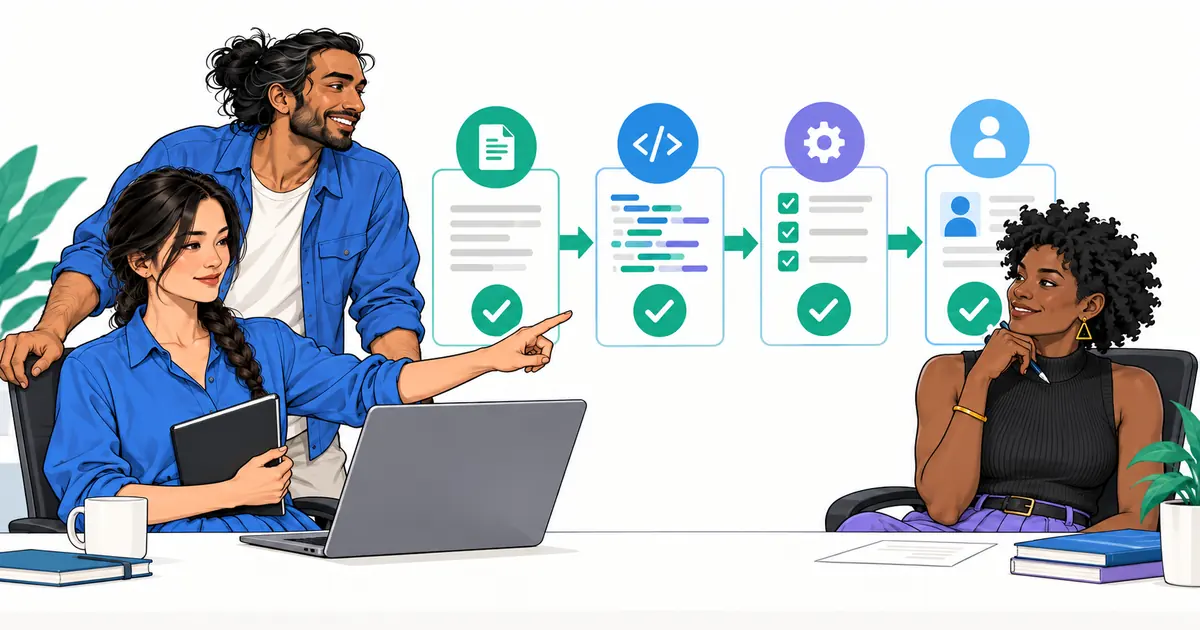
Trace one real change from request to release and inspect where intent, evidence, ownership, and stop decisions are lost. Start with one real change and make the evidence visible beside the work. Check accepted request, reviewable plan, executed checks, named release owner. If a reviewer still has to guess about scope, proof, or ownership, pause and repair that gap before scaling the practice. The result should be a workflow another qualified person can follow and challenge without relying on private chat or the original operator’s memory.
In this article
Last updated October 14, 2026
8 min read
The public wording behind this refresh can be seen in the question and discussion that surfaced the same practical uncertainty. It is a question source, not proof of the recommendation; the operational answer below is checked against the article’s authoritative sources.
Trace one real change from request to release and inspect where intent, evidence, ownership, and stop decisions are lost. The useful question is not whether the team can produce an impressive output once. It is whether the work remains understandable, reviewable, and safe when another person follows it under normal delivery pressure.
Why teams ask for an outside audit instead of running it internally
The honest reason is access. Internal AI usage is scattered across personal accounts, IDE extensions, browser tabs, and Slack conversations. A senior engineer inside the team can describe their own workflow well, but cannot see how the data team prompts, how the front-end developers paste boilerplate into Cursor, or which junior is quietly running a coding agent against the production repo. Zluri’s 2025 sprawl report found that mid-sized engineering organisations had over 200 distinct AI-touching tools in use, often with overlapping subscriptions. Self-reporting misses most of that.
The second reason is incentive. An internal lead who picked the current toolchain is a poor judge of whether it should be replaced. An outside audit is read as neutral. People answer the questions honestly because the auditor does not own the outcome.
We have AI tools, but no workflow.
That sentence comes up in almost every kickoff call. It is what triggers the engagement.
- Access problem: AI usage is spread across accounts, IDEs, browser tools, and private habits.
- Incentive problem: The person who chose the current toolchain should not be the only person judging it.
- Evidence problem: The team needs observable workflow data, not another opinion about whether AI feels useful.
What the audit covers in the first two weeks
The work splits into three passes. First, a usage map. Every AI tool in the team, every account, every billing line, every license, every shadow login. The map separates active use from forgotten subscriptions. It is the only artefact that tells the CFO what the company is actually paying for.
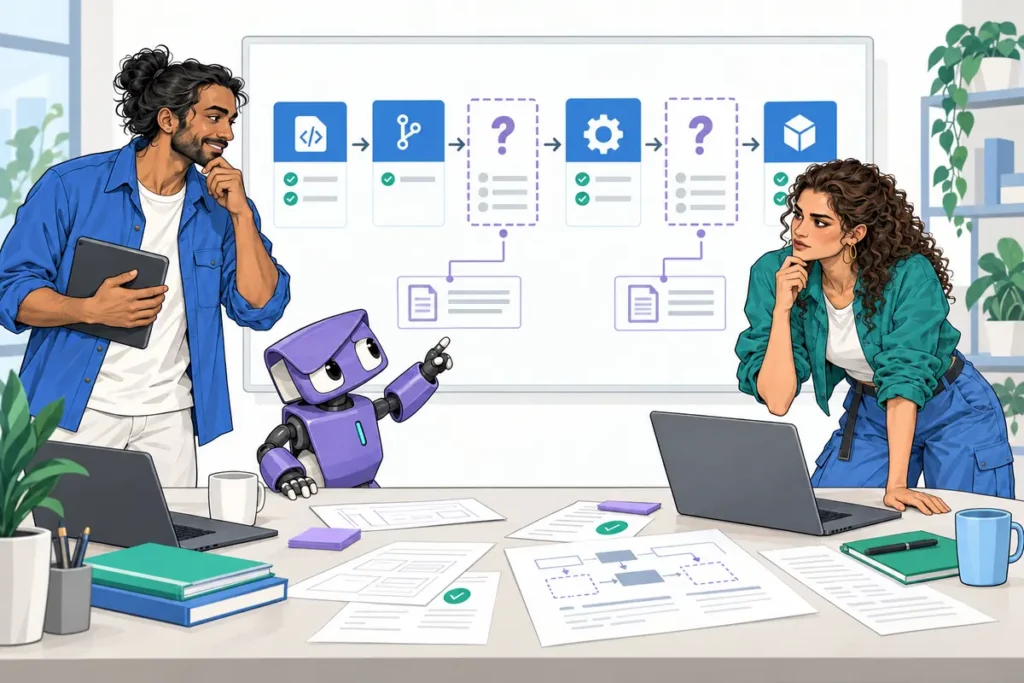
Second, a workflow trace. The audit follows three real tickets through the team’s process from prompt to merged PR. This is where the audit catches the patterns nobody describes in stand-up: the agent that quietly deletes failing tests, the prompt template a senior engineer copies into every chat, the review comment that says “looks fine” because the reviewer cannot tell which lines the human wrote.
Third, review a representative sample of recent AI-assisted pull requests. Classify the rework by cause: unclear intent, wrong scope, weak tests, repository-rule violations, or review delay. The team’s own sample is more useful than a vendor benchmark because it points to the exact workflow boundary that needs repair.
- Map active tools. Separate tools the team actually uses from forgotten licences and personal experiments.
- Trace real tickets. Follow three recent tickets from prompt to merged PR so workflow failures become visible.
- Review recent output. Read AI-generated PRs from the last 30 days and group failures by cause.
What the audit reveals that internal reviews miss
Three findings show up in almost every engagement.
The first is practice variance. When each developer invents a private way of prompting, planning, checking, and reporting, the team cannot compare outcomes or teach the method. A shared workflow turns the useful parts into an inspectable team practice.
The second is shadow AI. Continuus’s research on AI sprawl describes shadow AI as engineers running tools the security team has not approved and IT cannot see. In every audit so far, the shadow tool count is at least double what the engineering manager estimates before kickoff.
The third is review overload. When pull requests arrive faster than qualified reviewers can understand them, review age rises and attention thins. The audit should measure arrival, completion, and risk by lane before recommending more generation.
What the deliverable actually looks like
The audit ends with a written report and a one-page workflow diagram. The report has four sections: current state map, three biggest risks, three improvements to apply this sprint, and a 90-day plan. No 40-page deck. No theoretical AI strategy. The 90-day plan names the tools to consolidate, the prompting standard to write, the review steps to add, and the metric to track at week 12.
The improvements are sequenced for return on time, not for impressiveness. A team that deletes two redundant licences and adds a shared prompt library in week one feels the audit pay for itself before the report is fully read.
- Single source of truth for AI tooling decisions
- Documented prompting standard the whole team can follow
- Updated review checklist that catches AI-specific failure modes
- Three improvements scheduled into the next two sprints
- Twelve-week metric so the team can see progress, not just feel it
When an audit is the wrong starting point
Not every team needs an audit first. If the engineering organisation has fewer than five engineers and a single primary AI tool, the audit is overkill. The same is true if the team has no AI usage yet and is in the planning stage. The audit is for teams already using AI at enough scale that the cost of unstructured adoption is showing up somewhere: in review time, in incident counts, in licence spend, or in the gap between what leadership expected and what the team is shipping.
If you are not yet at that scale, the better first step is a workflow design session, not an audit.
If fewer than five engineers use one AI tool, write the workflow first. If multiple teams use multiple AI tools, run the audit before buying more licences. If AI is not in use yet, design the pilot before auditing the process.
Use a four-part evidence check
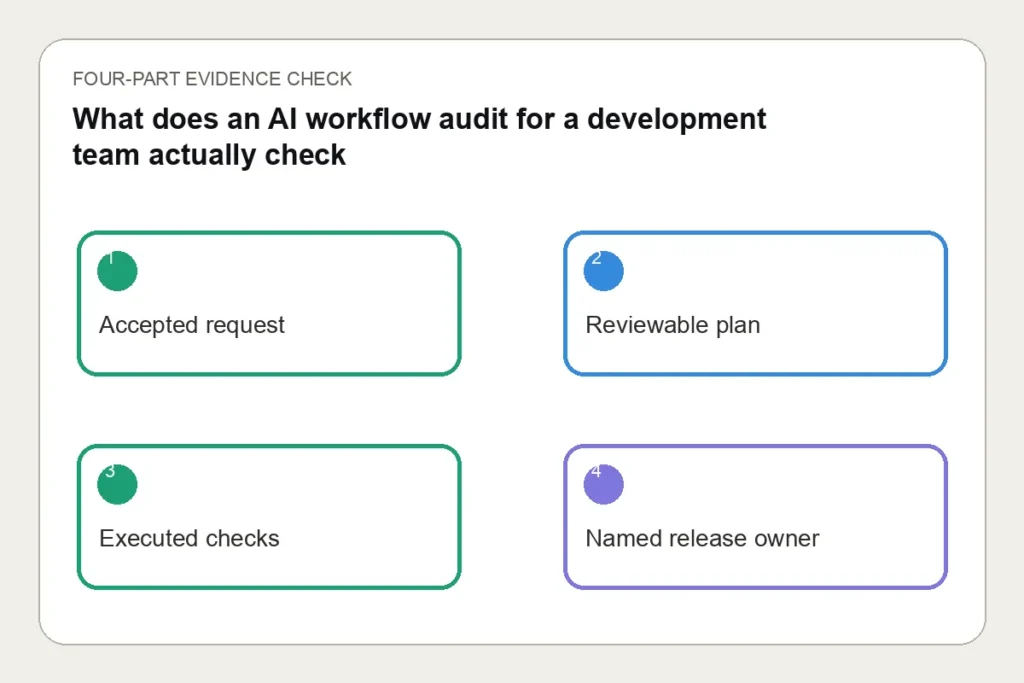
The practical test is whether another qualified person can understand the work without the original operator narrating it. For what does an ai workflow audit for a development team actually check?, inspect four things together. A polished output with a missing decision owner is still weak. A detailed policy with no repository evidence is equally weak.
| Review surface | Question to ask | If the answer is unclear |
|---|---|---|
| Accepted request | Can the team point to it without reconstructing the story from chat? | Write it down beside the work. |
| Reviewable plan | Is the boundary explicit enough that two reviewers would reach the same starting point? | Narrow the scope before continuing. |
| Executed checks | Does the evidence show what ran, what changed, and what remains unknown? | Retain the result as a review artifact. |
| Named release owner | Is one person accountable for accepting, changing, or stopping the work? | Name the owner before the next handoff. |
This worksheet is intentionally small enough to use on a real change. Start with one recent item that felt slow, risky, or surprisingly hard to review. Follow it from the original request to its present state. Record where a reviewer had to guess, where evidence disappeared, and which decision arrived late. The gaps show whether the next improvement belongs in documentation, automation, planning, review capacity, or ownership.
For example, imagine that the final code looks plausible and the tests are green, but nobody can connect the change to an accepted requirement. More testing will not repair that missing intent. The team must recover the requirement, decide whether the implementation still fits it, and preserve that link for the next reviewer. The same logic applies when the request is clear but the executed checks, risk boundary, or approval are missing.
Use one stop rule: if the person responsible for the outcome cannot explain what evidence supports the next step, pause before widening the change. Trace one real change from request to release and inspect where intent, evidence, ownership, and stop decisions are lost. This keeps speed connected to a decision the team can defend.
For adjacent decisions, use the Eliyce guides on how to handle ai generated code review and how to handle ai coding agents done.
If this problem is affecting live delivery, Eliyce can help you turn the diagnosis into a bounded AI delivery change with explicit evidence and decision points. See the relevant Eliyce service.
Frequently Asked Questions
What does an AI workflow audit for a development team actually check?
Trace one real change from request to release and inspect where intent, evidence, ownership, and stop decisions are lost. Apply it to one real change first, then keep the evidence beside that change so another reviewer can follow the reasoning.
How do you know whether AI-assisted development is safe enough to scale?
Start with accepted request and reviewable plan. Together they show whether the work has a clear boundary and whether the team can evaluate it without relying on memory.
Should an outside AI workflow audit inspect every repository?
Usually no. Start with a small sample of recent changes that includes an ordinary change, a risky change, and one that caused rework. If the same break appears across that sample, widen the audit only far enough to learn whether it is systemic.
What access does an AI workflow auditor actually need?
The auditor needs the request, plan, code change, review discussion, executed checks, release decision, and the rules that governed the work. Broad production access is unnecessary when those artefacts can be inspected safely in a controlled workspace.
How can an audit separate a tool problem from a workflow problem?
Repeat the same bounded task with the required process visible. If different tools fail at the same handoff, the workflow is the likely cause; if one tool fails despite identical context and controls, investigate that tool or its configuration.
What should the final audit deliverable contain?
It should name each broken handoff, show the evidence behind the finding, rank the risk, assign an owner, and propose a small repair with a retest date. A maturity score without those details gives leadership little they can act on.