Last updated May 8, 2026
6 min read
AI Workflow Audit Services for Development Teams: What the Review Should Prove
AI adoption in development teams rarely fails because nobody tried the tools. It fails because nobody reviewed the workflow around the tools.
AI workflow audit services for development teams review how engineers use AI across planning, coding, review, testing, documentation, and delivery. A good audit maps active tools, finds shadow usage, checks where AI creates review debt, and gives the team a practical 30 to 90 day plan for safer, more consistent adoption.
The question is not whether developers are using AI. In 2025, the answer is usually yes. The better question is whether the team can trust the work that AI helps produce.

Tool adoption is not the same as workflow adoption
Google Cloud’s 2025 DORA research describes AI as an amplifier of the existing organisational system. That is the right lens for development teams. If your review process is strong, AI can increase throughput. If the process is weak, AI can increase the amount of work nobody has properly checked.
High adoption creates a measurement problem. One team uses Cursor for repo-wide edits. Another uses Copilot for inline completions. A senior engineer uses Claude for test ideas. A product manager pastes acceptance criteria into ChatGPT. Someone runs an agent locally and only shows the cleaned-up pull request.
None of that is automatically bad. It becomes a problem when the team cannot answer basic operational questions: which tools touch source code, what data enters them, how generated output is reviewed, where decisions are documented, and whether the promised productivity gain is visible in delivery metrics.
An audit exists to answer those questions with evidence.
What an AI workflow audit should inspect
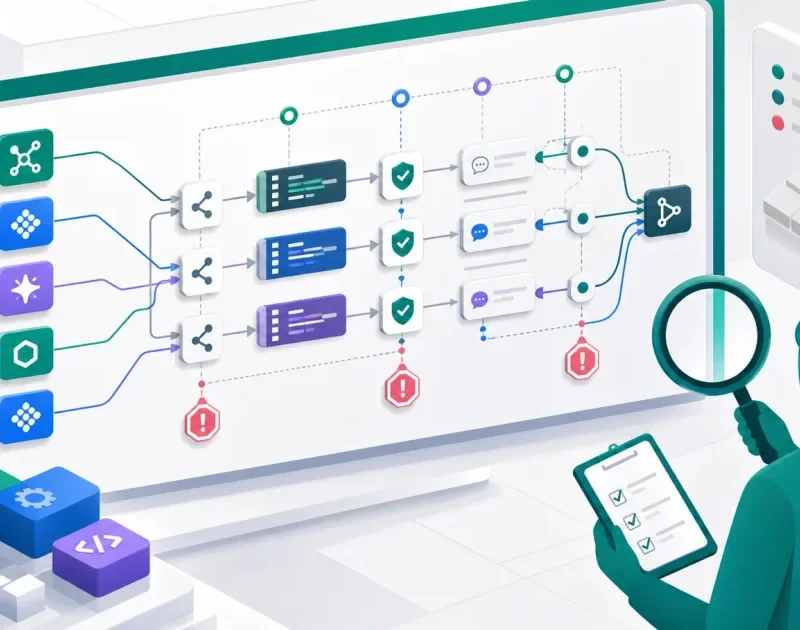
The audit should follow work, not just subscriptions. Tool lists are useful, but they miss the path from idea to merged code.
The review should include interviews, repository sampling, pull request analysis, tool billing, policy review, and at least three real ticket traces. A ticket trace is simple: start with a completed piece of work, then follow every AI touchpoint from planning to merge. That shows the workflow the team actually uses, not the workflow it describes in meetings.
The audit should separate speed from trustworthy delivery
Most teams can point to places where AI feels faster. That is useful, but it is not enough. A development team does not need more output if the output creates review debt, security risk, or inconsistent architecture.
The 2025 arXiv field experiment on experienced open-source developers is a useful warning. In that setting, developers expected AI to reduce completion time, but the study found tasks took longer when AI tools were allowed. The authors studied mature repositories and experienced developers, which is close to the environment where many serious product teams operate.
| Signal | Looks good at first | What the audit checks |
|---|---|---|
| More pull requests | Higher activity | Whether review quality drops |
| Faster first drafts | Shorter coding time | Whether debugging time moves later |
| More tests generated | Better coverage | Whether tests assert real behaviour |
| More documentation | Better context | Whether docs match current decisions |
| More tools available | Better choice | Whether the team has tool sprawl |
This is the distinction that matters. Speed is not the same as throughput. Throughput is useful work reaching production without increasing risk faster than the team can manage it.
Review debt is the hidden cost of AI-assisted coding
AI-generated code changes the review job. The reviewer is no longer checking only whether a teammate made a reasonable choice. They are also checking whether a model invented a pattern, missed a business rule, deleted a subtle guard, or wrote tests that confirm the implementation rather than the requirement.
AI can make code appear complete before the team has proved it is correct.
That is why an audit should inspect recent pull requests. The reviewer should look for repeated patterns: large AI-assisted diffs with thin explanations, tests added without meaningful assertions, new dependencies introduced without discussion, style drift across the codebase, and documentation updates that lag behind behaviour changes.
The audit should also inspect how the team marks AI involvement. Some teams add a pull request checklist item. Some tag AI-assisted commits. Some require a short note when generated code touches security, billing, permissions, or data migration. The exact mechanism matters less than the discipline. Reviewers need to know when extra scrutiny is required.
The useful deliverable is a 30 to 90 day operating plan
A good audit does not end with a lecture about responsible AI. It ends with changes the team can run.
The plan should be small enough to execute. If the audit recommends 27 policy changes, nobody will follow it. If it recommends three changes tied to actual workflow pain, the team can start immediately.
Frequently Asked Questions
How do we audit our team's AI tool usage?
Start with tool inventory, billing records, browser and IDE usage, repository sampling, and short engineer interviews. Then trace real tickets from idea to merge. The goal is to see where AI touches code, data, review, tests, and documentation, not just which subscriptions exist.
What does an AI workflow audit cover?
It covers active tools, shadow AI usage, prompt practice, generated-code review, testing, documentation, security exposure, governance, and delivery metrics. The best audits follow real engineering work so the findings reflect daily behaviour instead of policy documents.
How long does an AI workflow audit take?
For a focused development team, two to four weeks is a practical range. A small team with one repo and a few tools may finish faster. A multi-team product organisation with many repos, mixed tools, and unclear ownership needs more time.
Should we hire a consultant or pick an internal AI champion?
Use both for different jobs. An outside consultant is useful for the audit because they do not own the current tool choices. An internal champion should own the operating plan after the audit, keep standards current, and make sure the workflow survives past the first month.
What deliverables should we expect?
Expect a current-state map, tool inventory, workflow risk register, pull request review findings, policy gaps, and a 30 to 90 day improvement plan. The deliverable should name the first three changes to make, not only describe the problem.
Will an AI workflow audit force us onto one tool?
No. One-tool standardisation is not always the right answer. Some teams need different tools for different tasks. The audit should recommend clear governance: approved use cases, data boundaries, review rules, and retirement of tools that do not earn their place.
What next?
If your development team already uses AI but cannot explain where it helps, where it creates risk, or how generated work is reviewed, start with an audit. More tools will not fix a workflow nobody has mapped.