Last updated May 7, 2026
4 min read
AI generated code does not remove code review. It moves the hard work into a smaller, stricter workflow.
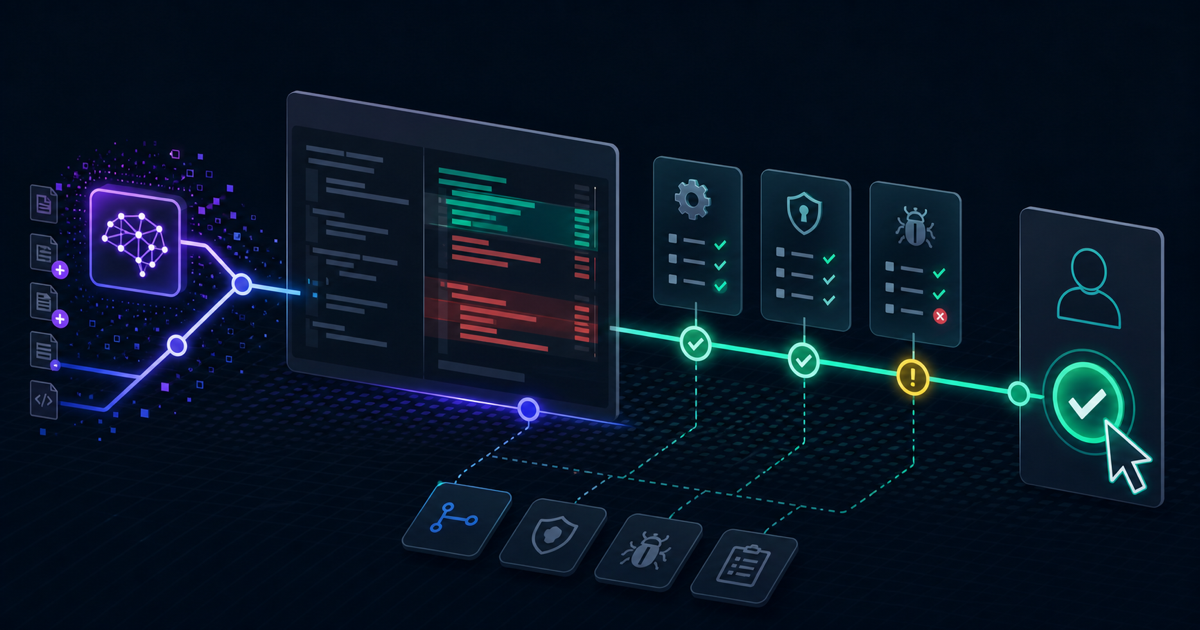
AI generated code should be reviewed through evidence, not confidence. Keep each pull request small, require tests before human review, preserve the prompt and acceptance criteria, and make the author explain the business rule. If nobody can describe what changed, the code is not ready for production.
The source question came from a developer facing large AI-written diffs under management pressure: how do you even review AI code?. That pressure is familiar. The answer is not to read faster. It is to reduce the size and raise the proof.
AI generated code needs smaller reviews
A 2,000 line pull request is not easier because Cursor, Claude Code, GitHub Copilot, or Codex helped write it. It is still 2,000 lines of behavior someone has to own.
Set one rule first: one behavior change per pull request. If the agent creates a full feature, split it before review. Keep the prompt, acceptance criteria, and file list in the PR description. Ask the author to name the business rule in plain language before anyone reviews style.
This changes the review from archaeology to verification. You are no longer asking what happened across 18 files. You are asking whether this one slice satisfies the contract and whether the tests prove it.
AI review fails when the diff is larger than the team can explain.
Tests should fail before humans do
A human reviewer should not be the first test gate. Run the mechanical checks before serious review time starts:
./vendor/bin/sail test
./vendor/bin/sail pint --test
npm audit --audit-level=high
The exact commands depend on the stack. The standard does not. CI, static analysis, dependency review, and secret scanning should run before a reviewer spends an hour reading generated code.
Tests do not prove the design is good. They prove known behavior still holds. That is enough to protect reviewer attention. Once basic verification passes, the human review can focus on permissions, data writes, billing paths, external APIs, queues, and migrations.
AI can assist review, but it cannot own it
Using AI to summarize a diff is reasonable. Treating that summary as approval is not.
Ask the model for mechanical help: list changed files, identify new dependencies, find untested branches, explain data flow, and flag security-sensitive paths. Then check the answer against the code. The final judgment still belongs to the developer who commits the change.
This matters because models can sound certain while missing product context. A patch can pass tests and still misunderstand tenant boundaries, invoice rules, or audit logging. The reviewer has to compare the implementation against the business rule, not only against syntax.
The reviewer needs a visible checklist
Review pressure gets easier to manage when the gate is written down. A practical AI generated code checklist has 5 items: task brief attached, diff under the team size limit, tests for changed behavior, no unapproved dependencies, and one named owner who can explain the change.
That checklist helps leadership too. It turns pushback into a release standard. The team is not saying AI is bad. It is saying production code needs evidence, no matter who or what wrote the first draft.
If management wants velocity, this is the honest version: faster generation only helps when review stays possible.
| Review signal | Weak version | Strong version |
|---|---|---|
| Task context | Prompt missing | Prompt and acceptance criteria attached |
| Diff size | Large feature branch | One behavior change per pull request |
| Ownership | Nobody can explain it | Named owner explains the business rule |
Frequently Asked Questions
How do you even review and understand AI generated code anymore?
Start by refusing the giant diff. Ask for the change to be split by behavior, then review one slice at a time. For each slice, check the business rule, edge cases, test evidence, new dependencies, and rollback path. AI generated code is still owned by the developer who submits it.
Should AI generated code be reviewed differently than human code?
The standard should be the same, but the review emphasis changes. With AI generated code, spend less time judging style and more time proving intent. Check whether the code solves the right problem, whether the tests were written from requirements rather than from the implementation, and whether subtle business rules survived.
What should reviewers check when AI code looks correct?
Check boundaries first: empty inputs, invalid permissions, large data sets, missing configuration, failed dependencies, and rollback behavior. AI code often looks coherent on the happy path. The useful review question is not "does this compile?" It is "what breaks when production behaves differently from the prompt?"
What next?
If your team is using AI tools but review has become the bottleneck, the issue is workflow design, not tool choice.