TL;DR
Treat documentation as part of the change, with an owner and a check at the same time as code review. Let the agent propose updates to module maps, interfaces, runbooks and decisions, then have the responsible human verify what is true. Mark which code change made each document stale. Documentation stays useful when drift creates visible work instead of a future clean-up promise.
In this article
6 min read
These two reader concerns frame the article: How do you keep documentation current for both developers and AI coding agents? and Should an AI agent update documentation when it changes code?. The links show the wording and context of the questions; the answer below uses primary or official sources for material claims.
Weak signal and stronger evidence
| Weak signal | Stronger evidence |
|---|---|
| The agent or tool says the work is complete | The named result is checked against the exact revision |
| A policy exists in a document | The rule is visible in the working delivery path |
| More output is produced | Accepted outcomes improve without hidden review debt |
README-only thinking misses the real surface
Documentation includes API contracts, error catalogs, runbooks, architecture decisions, user guidance, migration notes, examples, module rules, and support playbooks. The correct set depends on changed behavior. A blanket update the README task is usually too vague to help.
Metamon code-documentation inconsistency research supports the boundary. A research prototype over 9,482 pairs from five Java projects; it does not show AI causes drift.
| Evidence point | Inspectable value |
|---|---|
| 1 | Error before: 409 |
| 2 | Error after: 422 |
| 3 | Four affected documents |
| 4 | One explicit owner per surface |
Use this as a diagnostic. Replace illustrative entries with current repository evidence before making a policy, staffing, or release decision.

Trace one behavior change across every reader
Use an illustrative API change from a 409 conflict response to a 422 validation response. The code diff points to more than an API reference. It may affect client examples, an error catalog, support guidance, monitoring rules, a migration note and the instructions an agent loads before changing the module.
Create an affected-document record before editing prose:
| Surface | Question | Evidence of completion |
|---|---|---|
| API contract | Does the response and schema match behavior? | Contract test and rendered reference |
| Developer example | Does copied code handle the new response? | Executed example or reviewed fixture |
| Operations runbook | Does alert or recovery guidance use the old state? | Owner review against current monitoring |
| Product/support text | Does the user explanation remain accurate? | Product owner approval |
| Agent context | Will the next session retrieve the new rule? | Retrieval test on the current revision |
An agent can propose this set from symbols, routes, schemas and repository links. The owners of those surfaces still decide whether the text is correct and whether a documented no-change decision is credible.
Do not count modified files as the result. Verify the public behavior first, then compare each document with it. Run code examples where possible, validate schemas, resolve internal links and sample the retrieval path used by coding agents. If a document cannot be checked, label the limitation and assign follow-up instead of marking the surface complete.
Build an affected-document set from the diff
Derive affected surfaces from public symbols, changed routes, schemas, events, errors, configuration, dependencies, and product behavior. For each, record owner, current version, required action, and evidence. A deliberate no change decision should include a reason.
- Detect changed behavior. Record the owner, artifact, and completion evidence before the next transition.
- Map affected documents. Record the owner, artifact, and completion evidence before the next transition.
- Update or record no-change. Record the owner, artifact, and completion evidence before the next transition.
- Verify against live behavior. Record the owner, artifact, and completion evidence before the next transition.
Sequence matters because later evidence inherits the intent and scope established earlier. A skipped step transfers uncertainty to the final reviewer.
Verification must compare behavior and text
Metamon evaluated 9,482 code-document pairs across five Java projects and reported precision .72 and recall .48 for its detector. That demonstrates the difficulty and value of inconsistency detection. It does not show AI caused the drift or that automated sync can replace review.
Anthropic on context engineering provides a second evidence boundary. Vendor engineering guidance, not comparative outcome research.
Mistake: Adding update documentation as one undifferentiated checklist item. Fix: Compute API error runbook design and user surfaces, then record an owner and result for each.
The fix is procedural so the team can rehearse and audit it. A warning without ownership disappears when delivery pressure returns.
Fresh context reduces the next session’s guesswork
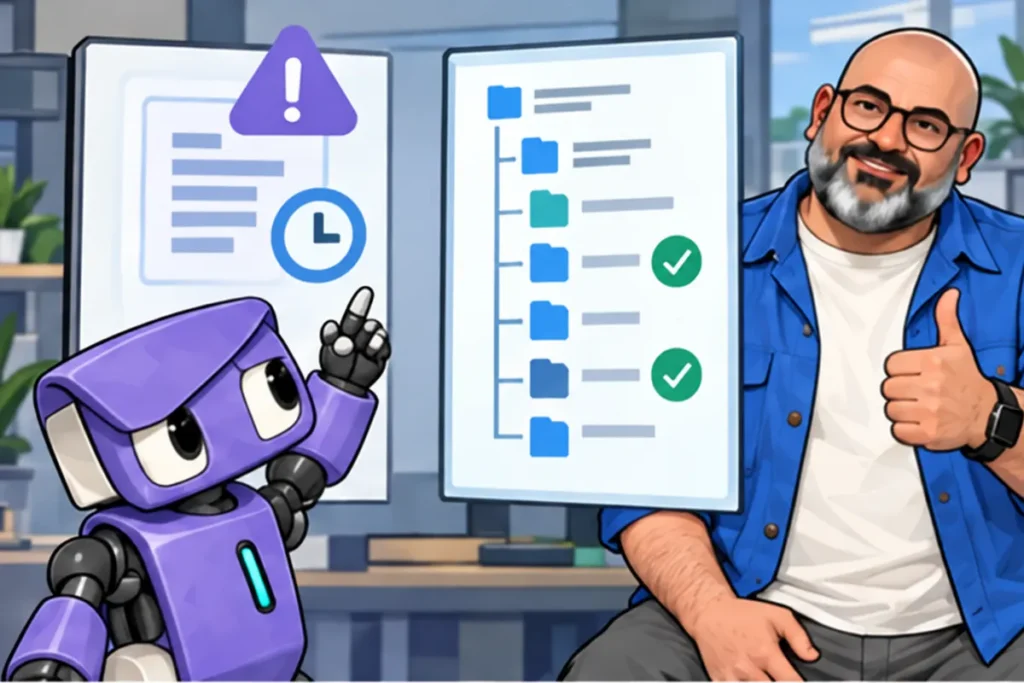
Context engineering guidance favors high-signal current information. Synced documentation makes later retrieval safer because sources have owners, revisions, and ties to live behavior. A stale document should be marked stale or invalidated instead of quietly remaining searchable.
Use the AI workflow audit guide for current-state mapping, compare the bar with production-ready AI code, and read the AI coding consultant guide when outside ownership is relevant.
- Behavior change identified
- Affected set complete
- Owners assigned
- No-change reasons recorded
- Retrieval sees current versions
Decision rule: Do not deliver a behavior change until every affected documentation surface is updated, invalidated, or explicitly marked unchanged by an owner.
Run the affected-document surface checklist in a 45-minute working review with the product owner, module owner, and final reviewer. Do not turn it into a score. Read the decision rule aloud: Do not deliver a behavior change until every affected documentation surface is updated, invalidated, or explicitly marked unchanged by an owner. Record disagreements, missing evidence, and the person responsible for the next action. Repeat the review after one real feature so the team can compare whether the artifact reduced ambiguity or only added paperwork.
Give every document a freshness rule
Different surfaces become stale in different ways. An API reference may be tied to a schema version, a runbook to a deployment and monitoring configuration, an architecture decision to the superseding decision, and agent instructions to repository paths and tool commands. Record the invalidation trigger beside the owner rather than relying only on a last-updated date.
Prefer generated reference material when code or schemas are the authoritative source, but review the generator and its coverage. Hand-written explanations remain necessary for rationale, product meaning and operational judgment. Mark which source wins when generated and narrative documentation disagree.
Track drift as delivery work. A failed example, broken internal link, stale retrieval result or reviewer correction should open a bounded update with an owner. Measure recurring causes, not document volume. If the same surface repeatedly falls behind, move its check closer to the code change or replace a manual copy with a trustworthy generated artifact.
Review search and retrieval as part of freshness. A current document that the team or agent cannot find is operationally absent, while a stale duplicate that ranks first can be worse than no documentation. Test common task wording, source priority and invalidation markers together.
Decision rule
Proceed only when the team can name the owner, inspect current evidence and stop or reverse the work without reconstructing an agent conversation.
Paqad is a first-party Eliyce product. Teams that want to test these controls on their own repository can explore the AI Delivery Programme.
Frequently Asked Questions
How do you keep documentation current for both developers and AI coding agents?
Treat documentation as part of the same change. Derive affected surfaces from changed behavior, assign owners, update or invalidate each source and verify it against the exact revision before delivery.
Should an AI agent update documentation when it changes code?
It can identify likely surfaces and draft changes, especially for mechanical references. A responsible owner must verify behavior, product meaning and operational guidance. The agent should record uncertainty rather than invent missing policy.
How do you know which documents a code change affects?
Trace changed routes, schemas, public symbols, errors, configuration, events and user behavior to their references. Repository links and ownership maps help, but the reviewer should also inspect indirect operational and support surfaces.
What should happen when documentation cannot be updated immediately?
Mark the source stale or invalid for the affected scope, explain the gap, name an owner and block any workflow that would treat it as current. A visible limitation is safer than searchable misinformation.
Can generated documentation replace architecture decisions?
No. Generated text can summarise an approved decision, but it cannot create the authority or rationale after the fact. Preserve who decided, alternatives considered, consequences and the revision where the decision applies.
How do you check that an AI agent retrieves the updated documentation?
Run a representative task on the current revision and inspect the cited sources or loaded context. Test that stale copies are excluded and that conflicts lead to a question or warning rather than silent selection.