Last updated May 6, 2026
6 min read
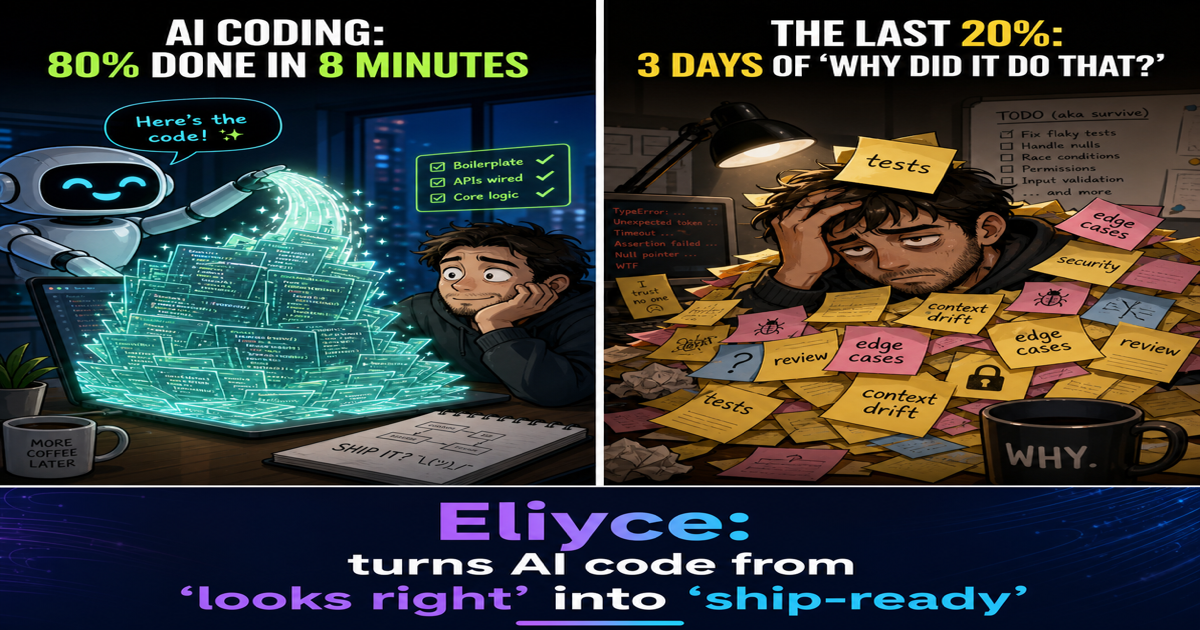
AI coding is not failing because it writes code. It is failing when teams treat generated code as understood code.
That is the real gap. The first draft appears quickly. The hard part starts when someone has to prove that the code fits the system, handles the edge cases, survives production, and can be changed by the next developer.
AI coding verification debt is the review, testing, security, and context work that piles up when generated code enters the codebase faster than the team can understand it.
The output is fast. The trust is not.
Sonar’s 2026 State of Code Developer Survey found that developers estimate 42% of committed code is now AI-generated or AI-assisted. The same survey found that 96% of developers do not fully trust AI-generated code, and only 48% always verify it before committing.
That tension matters more than the headline productivity number.
If your team generates code faster but does not improve verification, the bottleneck moves. It leaves the keyboard and lands in review, QA, staging, incident response, and architecture decisions.
Stack Overflow’s 2025 Developer Survey points in the same direction. More developers actively distrust AI tool accuracy than trust it, and experienced developers are especially cautious. That is not anti-AI sentiment. It is accountability. The person responsible for production behavior knows that plausible code is not the same as safe code.
The useful question is not whether AI can write code. It can.
The useful question is whether your team can explain, test, and own the code after AI writes it.
Verification debt starts with code nobody has mentally built
Technical debt usually lives in the code. Verification debt lives in the gap between code that exists and code the team understands.
When a developer writes a feature by hand, they build a mental model while writing it. They make small decisions, notice trade-offs, hit the awkward parts, and learn where the system pushes back.
AI changes that sequence.
The team can receive a complete-looking function, migration, API handler, or test suite before anyone has walked through the decisions. The code may compile. It may pass the obvious path. It may even look cleaner than the surrounding system.
But nobody has paid the comprehension cost yet.
That cost does not disappear. It shows up later as questions:
- Why did it choose this abstraction?
- What input shape does it assume?
- Which failure mode is missing?
- Does this match our permission model?
- What happens when the integration times out?
- Can the next developer safely change it?
The danger is not that AI is always wrong. The danger is that AI can be almost right at a scale your existing review process was not designed to absorb.
Production exposes what the prompt could not see
AI coding tools see the context you give them. Production sees everything else.
A VentureBeat report on Lightrun’s 2026 State of AI-Powered Engineering research described a survey of 200 senior SRE and DevOps leaders. The reported finding was blunt: 43% of AI-generated code changes required manual debugging in production even after QA and staging.
That does not mean every team will see that exact number. It does show the shape of the problem.
Staging rarely carries the full mess of production: old records, partial data, unusual permissions, race conditions, inconsistent customer behavior, real latency, and integrations that fail in ways nobody included in the prompt.
AI is strongest when the task is bounded. It is weaker when the work depends on hidden history, product judgment, deployment habits, and messy operational context.
That is where production failures come from. The generated code solved the described problem. The system had a larger problem.
This is also why “the tests passed” is not enough if the tests were generated from the same shallow understanding as the code. AI can produce tests that confirm its own assumptions. Your review process has to challenge those assumptions.
AI review is not a replacement for engineering review
It is tempting to solve AI-generated code with more AI: one model writes the code, another reviews it, and the team accepts the result when both sound confident.
That can help with basic issues. It cannot be the whole gate.
A 2025 arXiv study on GitHub Copilot Code Review evaluated whether the tool could identify security vulnerabilities in labeled vulnerable code samples. The authors found that Copilot’s review often missed critical issues such as SQL injection, cross-site scripting, and insecure deserialization, while focusing more on low-severity style and typo feedback.
That pattern should feel familiar to anyone who has reviewed AI output. The feedback often sounds useful because it is specific. But specificity is not the same as coverage.
For production code, the review has to include checks that are outside the model’s comfort zone:
- security rules tied to your actual threat model
- architecture constraints tied to your codebase
- observability expectations tied to your operations
- test cases that challenge happy-path assumptions
- documentation that explains why the decision exists
AI can assist with each of those. It should not be the authority that signs off on them.
The fix is a workflow, not a ban
Banning AI coding is usually the wrong response. So is letting every developer use it however they want.
The teams that get value from AI coding treat it as a drafting layer inside a real engineering workflow. They make the review responsibility explicit.
A practical workflow can be simple:
- Define what AI is allowed to touch without senior review.
- Require a short explanation of generated code before merge.
- Separate generated tests from adversarial tests written to break assumptions.
- Run static analysis, security checks, and framework-specific validation before review.
- Document architecture decisions when AI introduces a new pattern.
- Track AI-assisted changes that later cause incidents or rework.
The point is not bureaucracy. The point is ownership.
If your team cannot explain a piece of code, it does not matter whether a person or a model wrote it. The code is a liability until someone can own it.
AI coding makes this more urgent because it increases output. More output is useful only when the verification system scales with it.
What next?
If your team is using AI coding tools but the review process still depends on individual judgment and hope, start by auditing the workflow before you add more tools.