
Last updated September 18, 2026
6 min read
AI Workflow Audit Services for Development Teams: What an Outside Review Actually Catches
Most engineering teams adopted AI coding tools faster than they adopted a workflow for using them.
In this article
The result is the situation Coder reported in its 2025 enterprise adoption study: teams expected step-change productivity, then watched the average gain settle near 10%. Tools arrived first. Workflow arrived late or never. The audit exists to reverse that order.
Why teams ask for an outside audit instead of running it internally
The honest reason is access. Internal AI usage is scattered across personal accounts, IDE extensions, browser tabs, and Slack conversations. A senior engineer inside the team can describe their own workflow well, but cannot see how the data team prompts, how the front-end developers paste boilerplate into Cursor, or which junior is quietly running a coding agent against the production repo. Zluri’s 2025 sprawl report found that mid-sized engineering organisations had over 200 distinct AI-touching tools in use, often with overlapping subscriptions. Self-reporting misses most of that.
The second reason is incentive. An internal lead who picked the current toolchain is a poor judge of whether it should be replaced. An outside audit is read as neutral. People answer the questions honestly because the auditor does not own the outcome.
We have AI tools, but no workflow.
That sentence comes up in almost every kickoff call. It is what triggers the engagement.
What the audit covers in the first two weeks
The work splits into three passes. First, a usage map. Every AI tool in the team, every account, every billing line, every license, every shadow login. The map separates active use from forgotten subscriptions. It is the only artefact that tells the CFO what the company is actually paying for.
Second, a workflow trace. The audit follows three real tickets through the team’s process from prompt to merged PR. This is where the audit catches the patterns nobody describes in stand-up: the agent that quietly deletes failing tests, the prompt template a senior engineer copies into every chat, the review comment that says “looks fine” because the reviewer cannot tell which lines the human wrote.
Third, an output review. The audit reads a sample of AI-generated PRs from the last 30 days. VentureBeat’s 2025 enterprise survey found that 43% of AI-generated changes needed debugging in production. The review is how you find out whether your team sits above or below that line, and which kinds of changes account for the failures.
What the audit reveals that internal reviews miss
Three findings show up in almost every engagement.
The first is prompting variance. The teams without shared prompting practice see a productivity gap of around 60% versus teams with structured prompting, according to the DX adoption framework. That is not a tooling fix. It is a workflow and training fix that no licence upgrade closes.
The second is shadow AI. Continuus’s research on AI sprawl describes shadow AI as engineers running tools the security team has not approved and IT cannot see. In every audit so far, the shadow tool count is at least double what the engineering manager estimates before kickoff.
The third is review collapse. When AI generates 30% to 50% of a team’s code, the existing review process bends. Reviewers spend less time on each PR because there are more PRs. Bugs that linters miss become more frequent. The audit produces the new review checklist before the bug count produces it for you.
What the deliverable actually looks like
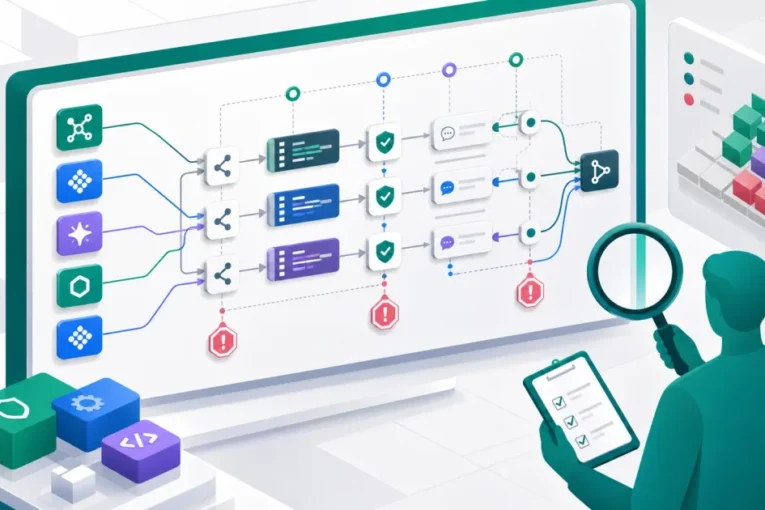
The audit ends with a written report and a one-page workflow diagram. The report has four sections: current state map, three biggest risks, three improvements to apply this sprint, and a 90-day plan. No 40-page deck. No theoretical AI strategy. The 90-day plan names the tools to consolidate, the prompting standard to write, the review steps to add, and the metric to track at week 12.
The improvements are sequenced for return on time, not for impressiveness. A team that deletes two redundant licences and adds a shared prompt library in week one feels the audit pay for itself before the report is fully read.
When an audit is the wrong starting point
Not every team needs an audit first. If the engineering organisation has fewer than five engineers and a single primary AI tool, the audit is overkill. The same is true if the team has no AI usage yet and is in the planning stage. The audit is for teams already using AI at enough scale that the cost of unstructured adoption is showing up somewhere: in review time, in incident counts, in licence spend, or in the gap between what leadership expected and what the team is shipping.
If you are not yet at that scale, the better first step is a workflow design session, not an audit.
Frequently Asked Questions
How long does an AI workflow audit for a development team take?
A standard audit runs two to four weeks. The first week is data collection: tool inventory, billing pull, ticket sampling, and short interviews with five to eight engineers. The second and third weeks are analysis and review. The fourth is the report and the working session. Audits longer than four weeks usually mean the team has multiple sub-organisations and needs the work split into separate engagements.
What does an AI workflow audit cost?
Pricing depends on team size and tool count. A focused audit for a 10 to 25 engineer team typically lands between EUR 8,000 and EUR 18,000 in 2026 European pricing. The cost is recovered in the first sprint when the audit removes redundant licences or prevents one production rollback. If a vendor cannot give a fixed scope and price upfront, the engagement is not yet productised enough to deliver clean output.
Should we hire a consultant or pick an internal AI champion?
Both, in that order. The consultant runs the audit because the audit needs an outsider. The internal champion owns the 90-day plan after the report lands. A consultant who recommends becoming the permanent owner of your AI workflow is selling you the wrong shape of engagement. The goal is for your team to run the workflow without the consultant by day 91.
What if our developers resist a consultant evaluating their tools?
This shows up in roughly half of the engagements and is usually solved by framing. The audit is not a performance review of any individual engineer. It is a review of the system the company built around them. A good auditor interviews engineers in private, never names individuals in the report, and asks the team to validate the findings before the report is final. Resistance drops fast when engineers see their own pain reflected accurately back.
How is this different from an architecture review?
An architecture review looks at the codebase: structure, debt, risk, maintainability. An AI workflow audit looks at how the team works around the codebase: which tools they use, how they prompt, how they review AI output, how decisions get documented. They answer different questions. Some teams need both, sequenced. The architecture review tells you what the system is. The AI workflow audit tells you whether the team can change the system safely with AI in the loop.
Will the audit force us to standardise on one AI tool?
No. Forced standardisation is one of the patterns the audit usually flags as harmful. The 2026 enterprise comparisons from Adventure PPC and Cosmic JS both note that locked single-vendor stacks underperform mixed stacks for teams above 30 engineers. The audit recommends governance, not uniformity. Teams keep the tools that earn their seat. They retire the ones that do not.
What next?
If your team is already using AI at scale and the productivity story does not match the licence spend, the audit is the fastest way to see what is actually happening before you spend more.