
Last updated September 18, 2026
5 min read
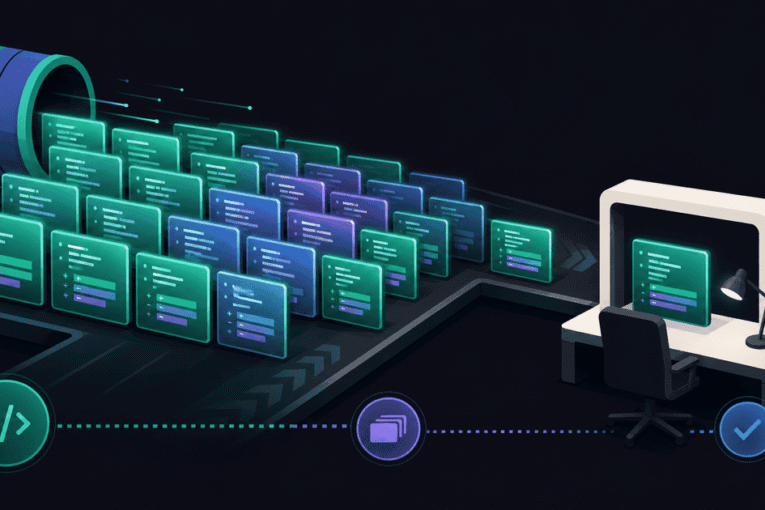
AI code review capacity becomes the bottleneck the moment agents open pull requests faster than people can understand them.
A fictional 14-engineer SaaS team illustrates the trap. Its agent reduced coding time on routine changes, so pull requests arrived earlier and in larger clusters. Review age doubled. The team had optimized typing while leaving the trust step unchanged.
In this article
Faster generation can make delivery slower
The queue is easy to miss because every developer looks busy. GitHub shows more open pull requests. The agent reports successful tests. Management sees output. Yet a change creates no customer value until someone with context decides it is safe to merge.
The 2025 DORA report describes AI as an amplifier of the system around it. That framing matters. If review is already constrained, more generated code feeds the constraint. DORA also reported 90% AI adoption among surveyed technology professionals, so this is no longer a niche capacity problem.
| Signal | Local speed view | System throughput view |
|---|---|---|
| Agent output | Lines or pull requests created | Changes safely merged |
| Queue | Work waiting for generation | Work waiting for qualified review |
| Quality | Tests reported as passing | Evidence tied to acceptance criteria |
| Delay | Coding duration | Time from request to verified delivery |
Track both views. A faster local step can coexist with a slower whole system.
Model the queue before adding another agent
Use a simple illustrative model. Let arrival rate be the number of reviewable changes submitted per day. Let service rate be the number reviewers can finish to the required standard. If 12 changes arrive while the team can properly review 8, the queue grows by 4. No productivity slogan changes that arithmetic.
Start with one week of data from your actual repository. Count opened pull requests, completed reviews, median review age, reopened work, and sensitive changes that needed a specialist. Split generated changes by risk, not by author.
The model is intentionally small. Its job is to expose the constraint before the team buys another coding seat.
Reviewer attention is the scarce resource
The 2025 Stack Overflow survey found that 66% of respondents named AI answers that were almost right as a frustration, while 45.2% said debugging AI-generated code took more time. Those are self-reported perceptions, not causal measurements. They still explain why review cannot be reduced to a quick approval click.
A reviewer must recover intent, inspect changed behavior, evaluate tests, check dependencies, and understand what the change did not prove. That work consumes attention. Adding people helps only when those people have the right module knowledge.
Review design can help. Keep diffs small. Attach the accepted specification. Put deterministic results next to the change. Route a payment migration to a payment-aware reviewer. The existing Eliyce guide on production-ready AI code gives a useful release-gate baseline.
This reduces context reconstruction without pretending review is free.
Choose an intervention that matches the constraint
Do not respond to a growing queue with a generic policy. Diagnose the reason. Large diffs need decomposition. Missing context needs better planning artifacts. Repeated low-risk work may justify a fast lane. Sensitive changes need protected specialist capacity. Weak tests need better evidence, not another reviewer.
Paqad-ai v1.67.0 is relevant here because it treats planning, specification, review, checks, and documentation as connected stages. It also routes work by complexity and risk. That design does not prove a productivity outcome for your team. It gives you a repository-owned structure to test.
For a broader operating view, compare the queue with an AI workflow audit and the role expectations in the AI coding agents consultant guide.
The decision rule is practical: if review age rises for two consecutive measurement periods, fix the review constraint before increasing generation.
Frequently Asked Questions
How do you calculate AI code review capacity?
Count the number of review-ready changes completed to your evidence standard during a fixed period. Compare that service rate with the arrival rate of new review-ready changes. Segment by risk because one copy edit and one authorization change consume different expertise. Use the trend to guide staffing, decomposition, and workflow changes.
Should teams limit AI-generated pull requests?
Limit work in progress when the review queue is growing, not AI use in the abstract. A temporary cap can protect reviewer attention while the team reduces diff size, improves evidence packets, or assigns specialist capacity. The target is stable, trustworthy flow. A blanket ban does not diagnose the real bottleneck.
Can an AI reviewer solve the capacity problem?
An AI reviewer can find patterns, summarize diffs, and run repeatable checks. It cannot own the final business decision or guarantee that its test oracle is complete. Use it to reduce mechanical work, then keep accountable human judgment for risk-bearing changes.
What next?
If generated work reaches review faster than your team can verify it, install paqad-ai and make the queue visible across planning, specification, checks, and review. Start with one repository, one workflow, and one week of actual arrival and completion data.