
Last updated September 18, 2026
4 min read
A fictional team runs 18 build-test-correct cycles before lunch. The feature still solves the wrong problem because the requirement never named which customer could approve the action. The loop became efficient at converging on an unapproved assumption. This is an explicitly fictional composite, used to expose a repeatable engineering decision without inventing a customer result.
In this article
Define Loop Engineering without turning it into hype
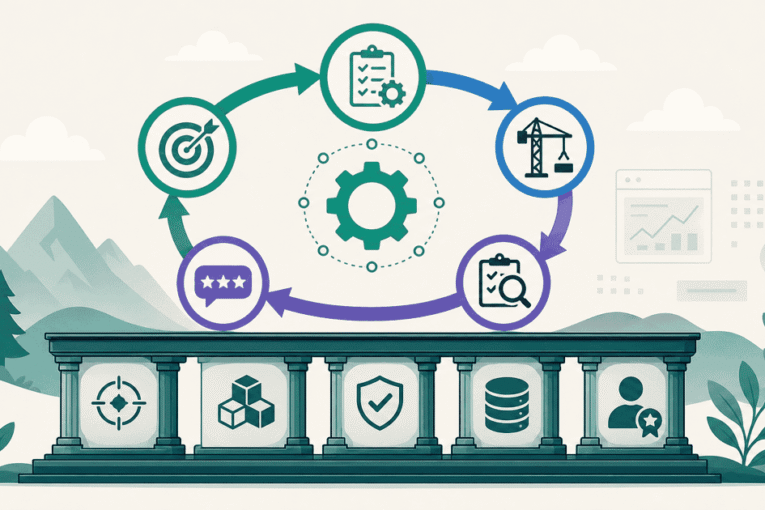
Loop Engineering is an early practitioner term for designing the system around repeated agent work. In this campaign, it means the plan-build-test-review-correct-and-stop loop around an AI worker. That operational definition is useful, but it is not an industry standard or a promise of autonomy.
Addy Osmani on Loop Engineering helps bound this point. Loop Engineering is an early practitioner frame, not a settled standard.
| Lens | What to inspect |
|---|---|
| 1 | 18 cycles: high activity |
| 2 | One unapproved assumption: wrong target |
| 3 | Strong core: correction toward intent |
| 4 | Weak core: repeatable drift |
The numbers and labels above are a diagnostic, not benchmark data. Replace them with repository evidence before using the model in a staffing or investment decision.
A loop amplifies its target and its blind spots
DORA’s amplifier framing offers the right caution. Better tools can increase the effect of the workflow they enter. If acceptance criteria are vague, tests share the implementation’s assumption, or nobody owns the stop decision, additional cycles can reinforce the same mistake. Speed changes exposure, not truth.
The sequence matters because later evidence depends on earlier intent. Skipping one step transfers uncertainty to a reviewer who has less time and often less context.
The core needs technical and human components
The core includes a versioned goal, architecture constraints, independent criteria, representative checks, compact state, a worker, a bounded verifier, decision memory, and a risk-based human gate. Not every feature needs a heavy version of each component. Every production loop needs to know where these responsibilities live.
Google DORA 2025 adds a second boundary. The report is observational, so associations should not be presented as universal causation.
The correction is deliberately procedural. A workflow can be inspected, rehearsed, and improved. A warning without an owner or artifact rarely survives the next busy sprint.
Test the foundation before increasing iteration
Run a foundation audit before adding more autonomous turns. Remove any loop whose goal cannot be stated, whose tests cannot fail on broken behavior, or whose stop condition is only token exhaustion. Fix one missing control, then compare correction quality and review burden over a bounded run.
paqad-ai v1.67.0 was the current public release when this article was verified on July 21, 2026. Its public repository describes local workflows, risk routing, specialist roles, deterministic checks, documentation sync, and audit records. Those are product mechanisms, not independent proof that a team will achieve a specific outcome.
Use the broader AI workflow audit guide to map the operating system, compare the evidence bar with production-ready AI code, and use the consultant selection guide when outside ownership is being considered.
The decision rule for this article is: Do not increase loop speed until the goal, evidence, state, authority, and stop condition are inspectable.
Frequently Asked Questions
Is Loop Engineering a standard method?
No. It is an emerging practitioner frame. Paqad uses a specific operational definition for designing plan, build, test, review, correction, memory, and stop behavior around an AI worker.
What is the strongest foundation element?
There is no single element. A good specification without meaningful tests leaves a gap. Strong tests without decision authority leave another. Inspect the whole correction path and find its weakest control.
Can a small team use governed loops?
Yes. Keep the state and gates compact. A small team still benefits from a written target, one independent check, a named decision owner, and a stop rule before repeated agent work begins.
What next?
If this failure pattern exists in your repository, install paqad-ai and test the decision tool above on one real feature. Keep the evidence local, inspect provider permissions, and retain human authority for the final risk decision.