
Last updated September 18, 2026
4 min read
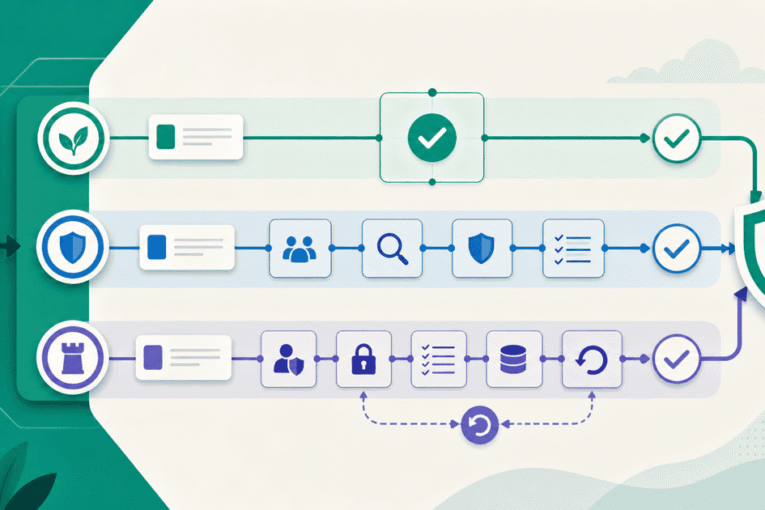
Two fictional tickets arrive together. One changes button copy. The other migrates payment state for 48,000 orders. Sending both through the same workflow either buries the copy edit in ceremony or exposes the migration to an unsafe shortcut. This is an explicitly fictional composite, used to expose a repeatable engineering decision without inventing a customer result.
In this article
Complexity and risk are different variables
A change can be technically small and operationally dangerous. Replacing one authorization condition may touch a single line while changing who can see customer data. Conversely, a broad documentation edit can touch many files with little production risk. Route on consequences, not file count alone.
NIST AI Risk Management Framework helps bound this point. This is voluntary risk guidance, not certification or proof of a product outcome.
| Lens | What to inspect |
|---|---|
| 1 | Copy: reversible and narrow |
| 2 | Payment migration: sensitive and wide |
| 3 | Fast lane: compact evidence |
| 4 | Full lane: specification, specialists, rollback |
The numbers and labels above are a diagnostic, not benchmark data. Replace them with repository evidence before using the model in a staffing or investment decision.
Sensitivity floors stop convenient downgrades
A sensitivity floor prevents the requester or agent from choosing a lighter lane because the task looks easy. Authentication, billing, destructive actions, production data, secrets, and irreversible migrations should establish a minimum control path. NIST guidance supports explicit risk roles and go or no-go authority, but leaves implementation to the organization.
The sequence matters because later evidence depends on earlier intent. Skipping one step transfers uncertainty to a reviewer who has less time and often less context.
Three lanes keep control proportional
A fast lane handles narrow, reversible work. A graduated lane adds planning, acceptance criteria, and normal review. A full lane adds a versioned baseline, specialist involvement, stronger verification, rollback, and explicit delivery evidence. The lane names matter less than the controls they preserve.
Google DORA 2025 adds a second boundary. The report is observational, so associations should not be presented as universal causation.
The correction is deliberately procedural. A workflow can be inspected, rehearsed, and improved. A warning without an owner or artifact rarely survives the next busy sprint.
Record why the route was chosen
Write the routing decision into the feature record with the signals used, the lane selected, the sensitivity floor, and the person allowed to override it. That record helps a later reviewer distinguish a reasoned exception from a silent shortcut.
paqad-ai v1.67.0 was the current public release when this article was verified on July 21, 2026. Its public repository describes local workflows, risk routing, specialist roles, deterministic checks, documentation sync, and audit records. Those are product mechanisms, not independent proof that a team will achieve a specific outcome.
Use the broader AI workflow audit guide to map the operating system, compare the evidence bar with production-ready AI code, and use the consultant selection guide when outside ownership is being considered.
The decision rule for this article is: Choose the lightest lane allowed by the highest sensitivity signal, not the shortest implementation estimate.
Frequently Asked Questions
What belongs in the fast lane?
Use it for narrow, reversible, low-sensitivity changes with clear behavior and cheap verification. Copy, comments, and isolated internal tooling may qualify when no sensitive module is crossed.
Who can override a lane?
Name the role in policy. The person needs context, evidence, and authority to accept the resulting risk. Record the reason and expiry so the exception does not become an unwritten default.
Can lane routing be automated?
Signals can be computed from modules, file paths, data classes, and change type. Keep human review for ambiguous or high-impact cases because the router cannot know every business consequence.
What next?
If this failure pattern exists in your repository, install paqad-ai and test the decision tool above on one real feature. Keep the evidence local, inspect provider permissions, and retain human authority for the final risk decision.