
Last updated September 18, 2026
4 min read
A skill can teach an agent how to review an API, write a migration, or inspect a design. A fictional 24-person platform team had dozens of useful skills and still could not answer who approved a changed billing rule. Task capability and lifecycle control solve different problems. This is an explicitly fictional composite, used to expose a repeatable engineering decision without inventing a customer result.
In this article
A skill improves one bounded capability
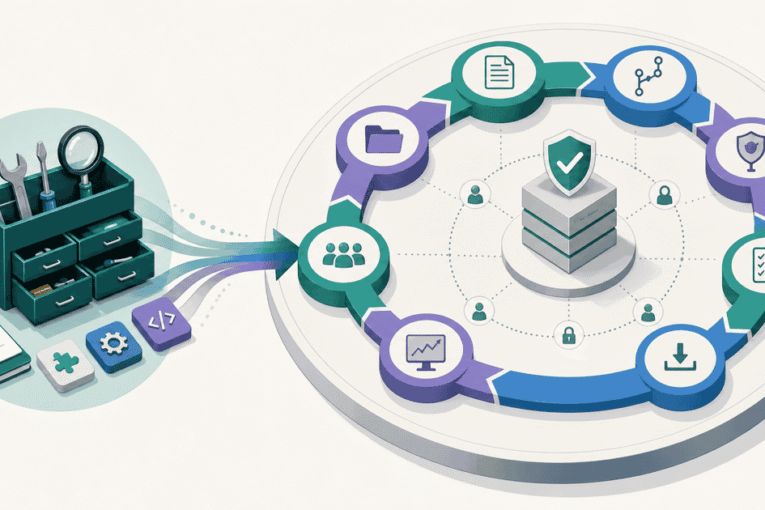
A well-designed skill can include procedures, scripts, references, and reusable assets. That is valuable when the agent needs specialist behavior. The boundary is important: a security review skill can inspect a change, but it does not automatically own the product decision, the accepted specification, or the permission to deliver.
NIST AI Risk Management Framework helps bound this point. This is voluntary risk guidance, not certification or proof of a product outcome.
| Lens | What to inspect |
|---|---|
| 1 | Skill: task procedure |
| 2 | Workflow: stage transition |
| 3 | Skill output: specialist result |
| 4 | Workflow output: decision and evidence trail |
The numbers and labels above are a diagnostic, not benchmark data. Replace them with repository evidence before using the model in a staffing or investment decision.
A team lifecycle owns transitions and authority
A lifecycle defines when work may move. The supplied paqad model uses eight connected stages from intake through delivery. At each transition, the repository can retain the plan, the versioned specification, executed evidence, an unresolved decision, and the named human authority. That structure survives a chat ending.
The sequence matters because later evidence depends on earlier intent. Skipping one step transfers uncertainty to a reviewer who has less time and often less context.
Enterprise maturity appears in inspectable artifacts
NIST guidance emphasizes explicit roles, traceability, testing, and go or no-go authority. It does not endorse paqad-ai or certify any tool. It does show why teams need controls outside a model’s confidence. Mature operation is visible in records a reviewer can inspect, not in an adjective on a product page.
Google DORA 2025 adds a second boundary. The report is observational, so associations should not be presented as universal causation.
The correction is deliberately procedural. A workflow can be inspected, rehearsed, and improved. A warning without an owner or artifact rarely survives the next busy sprint.
Choose the layer that matches the problem
If the problem is that an agent cannot perform a specialized task, add or improve a skill. If the problem is inconsistent feature flow across Claude Code, Codex, Gemini, or another host, address the shared lifecycle. Many teams need both layers, with clear ownership between them.
paqad-ai v1.67.0 was the current public release when this article was verified on July 21, 2026. Its public repository describes local workflows, risk routing, specialist roles, deterministic checks, documentation sync, and audit records. Those are product mechanisms, not independent proof that a team will achieve a specific outcome.
Use the broader AI workflow audit guide to map the operating system, compare the evidence bar with production-ready AI code, and use the consultant selection guide when outside ownership is being considered.
The decision rule for this article is: Use a skill for a bounded capability; use a repository-owned workflow when the problem spans stages, roles, evidence, and authority.
Frequently Asked Questions
Does paqad-ai replace Codex or Claude Code skills?
No. Skills can remain the specialist procedures agents use inside a stage. paqad-ai addresses the wider feature lifecycle and the repository-owned state that connects those stages.
Why does the distinction matter for enterprises?
Enterprises need repeatable ownership, evidence, and change records across people and providers. A capable task procedure is useful, but it does not by itself define who may accept risk or release a feature.
Can a small team use the same model?
Yes. Keep the lane proportional to risk. A low-risk change should stay light, while billing, authentication, or data deletion should carry stronger planning, evidence, and review.
What next?
If this failure pattern exists in your repository, install paqad-ai and test the decision tool above on one real feature. Keep the evidence local, inspect provider permissions, and retain human authority for the final risk decision.