
Last updated September 18, 2026
4 min read
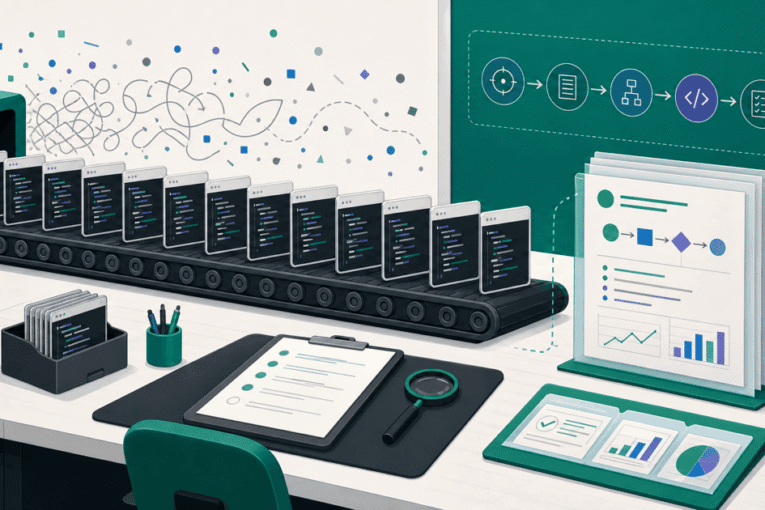
A fictional reviewer opens 11 pull requests before lunch. Each one is polished, overlong, and weakly tied to a ticket. Calling the author lazy would miss the cause. The team rewarded visible output, gave agents no stable acceptance criteria, and allowed large changes to reach review without evidence. This is an explicitly fictional composite, used to expose a repeatable engineering decision without inventing a customer result.
In this article
Define the output before judging the person
The term slop became mainstream language for low-quality AI output in 2025. In software, the useful definition is narrower than an internet insult: output arrives in volume, looks plausible, and transfers a disproportionate verification burden downstream. Required review alone does not make a draft slop.
Stack Overflow Developer Survey 2025 helps bound this point. The results are self-reported perceptions, not causal production telemetry.
| Lens | What to inspect |
|---|---|
| 1 | Visible output: 11 pull requests |
| 2 | Reviewable output: 2 scoped changes |
| 3 | Weak signal: polished diff |
| 4 | Strong signal: evidence tied to intent |
The numbers and labels above are a diagnostic, not benchmark data. Replace them with repository evidence before using the model in a staffing or investment decision.
Volume incentives create predictable review debt
A team creates the condition when it rewards pull request count, accepts vague tickets, and lets generated diffs grow without a stop rule. Eleven superficially complete changes can consume more reviewer attention than two well-scoped changes. The damage is organizational because the queue hides in other people’s calendars.
The sequence matters because later evidence depends on earlier intent. Skipping one step transfers uncertainty to a reviewer who has less time and often less context.
Not all AI-assisted code is structurally worse
Current evidence needs balance. Long-horizon benchmarks report incomplete trajectories and structural erosion under their test conditions. A controlled maintenance experiment found no significant downstream quality or completion difference in its bounded setting. Neither result licenses a universal claim about all AI-generated code.
Google DORA 2025 adds a second boundary. The report is observational, so associations should not be presented as universal causation.
The correction is deliberately procedural. A workflow can be inspected, rehearsed, and improved. A warning without an owner or artifact rarely survives the next busy sprint.
Replace the insult with a diagnostic
Run the diagnostic at the workflow level. Ask whether intent was baselined, the diff matches the requested surface, dependencies were verified, tests would fail on broken behavior, and someone can stop the change. If three answers are no, fix the pipeline before debating developer attitude.
paqad-ai v1.67.0 was the current public release when this article was verified on July 21, 2026. Its public repository describes local workflows, risk routing, specialist roles, deterministic checks, documentation sync, and audit records. Those are product mechanisms, not independent proof that a team will achieve a specific outcome.
Use the broader AI workflow audit guide to map the operating system, compare the evidence bar with production-ready AI code, and use the consultant selection guide when outside ownership is being considered.
The decision rule for this article is: If low-quality output arrives repeatedly, change the incentive or gate that admits it before blaming the developer.
Frequently Asked Questions
Is all AI-generated code AI slop?
No. The term should describe low-quality mass output, not the origin of every draft. AI-assisted code can be useful when the task is bounded and the evidence supports the change.
Why does the term cause conflict?
It often shifts attention from system design to personal judgment. Teams learn more by naming the missing specification, check, or ownership rule than by assigning a dismissive label.
What is the first practical fix?
Reduce work in progress and require a short evidence packet before review. That makes the missing intent, test, dependency, or decision visible while the change is still cheap to correct.
What next?
If this failure pattern exists in your repository, install paqad-ai and test the decision tool above on one real feature. Keep the evidence local, inspect provider permissions, and retain human authority for the final risk decision.