
TL;DR
Developer documentation should live beside the thing that makes it true. Put setup, commands, interfaces and code decisions in the repository so they change with the software. Keep business policy and cross-system ownership in the organisation’s governed knowledge space, then link to it from the repo. Use generated reference docs only for facts that can be generated. The aim is one discoverable route from a code change to its reason, operator and current proof, without copying the same explanation into several places.
In this article
- Match the document to its source of truth
- Make the repository the developer route
- Keep reasons close without narrating the code
- Do not duplicate a rule across locations
- Give every important page an owner and trigger
- Design documentation for humans and coding agents
- Repair discovery before writing more pages
- Frequently Asked Questions
7 min read
Documentation becomes untrustworthy when its location is chosen by habit. A wiki is easy to write in but may be far from the code it describes. A repository is close to implementation but cannot own every business policy. Comments are visible at the exact line yet become noise when they repeat what the code already says.
The useful question is where should developer documentation live so it stays current? Put each document next to the source that can invalidate it, assign an owner and create one navigation route across locations. Location should reduce the distance between a change and the documentation update it requires.
Match the document to its source of truth
Different kinds of knowledge change for different reasons. Treating “the docs” as one destination guarantees either duplication or gaps.
Comparison
| Knowledge | Best primary home | Why |
|---|---|---|
| Build, test and local setup | Repository README or linked repo docs | Code and tooling changes should update it in the same review |
| Public interface and schema | Generated reference plus source annotations | Machine-derived facts should follow the implementation |
| Architectural decision | Versioned decision record in the repository | The decision can be reviewed with later code consequences |
| Operating procedure | Runbook near the service and deployment system | Operators need version, owner and recovery steps |
| Business rule or policy | Governed organisational knowledge base | The business owner, not a code repository, approves it |
| Cross-system ownership | Service catalogue or central index | Teams need one view across repositories |
GitHub’s README guidance describes the repository README as the place to explain what a project does, why it is useful, how to start and where to get help. That makes it a front door, not a warehouse for every detail.
Make the repository the developer route
A developer opening the codebase should not need to guess which wiki, chat channel or ticket contains the current setup. Keep a short root README with the project purpose, supported environment, basic commands and links to deeper documents. Put contribution and test conventions where pull-request authors will encounter them.
Use relative repository links so documentation works for people who clone the project as well as those browsing it online. GitHub recommends relative links for this reason. Organise longer material by task: docs/development, docs/architecture, docs/operations or a structure that matches the system, rather than a single miscellaneous folder.
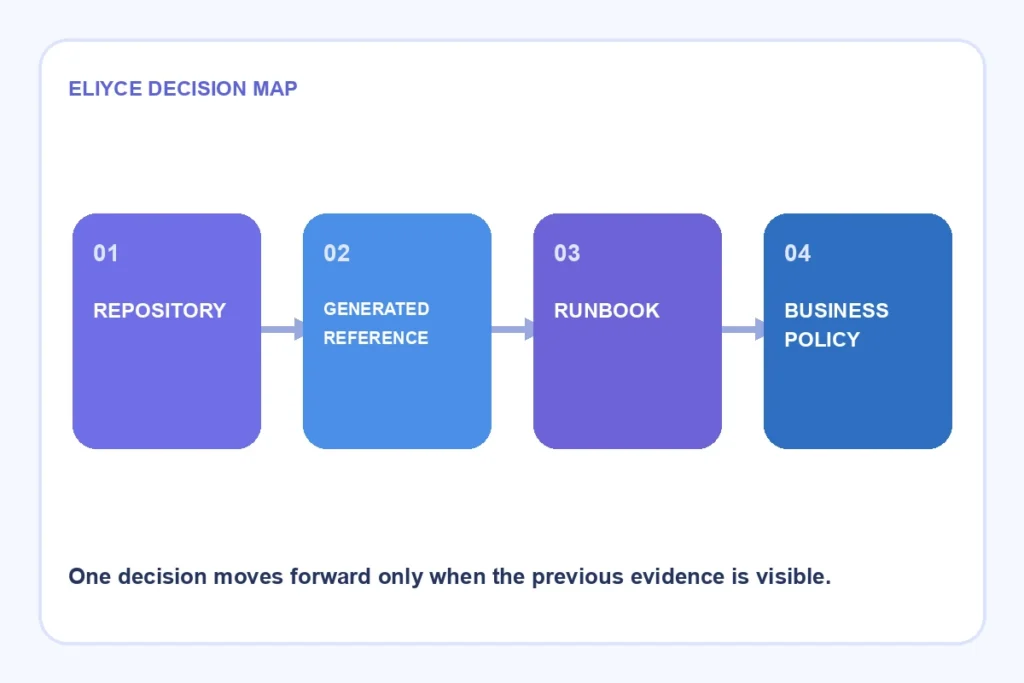
A repository document is especially valuable when it participates in the same review as the code. If a command, interface or operational step changes, the pull request can update both and reviewers can assess whether they agree.
Keep reasons close without narrating the code
Comments and docblocks should explain a constraint, decision or non-obvious consequence. They should not translate readable code into English. A comment that says “increment counter” will age badly when the implementation changes; a comment that explains why duplicates are tolerated for a recovery window may preserve an important decision.
Use an architectural decision record when the reason affects more than one local line: why the team chose an event boundary, accepted a dependency, retained backward compatibility or rejected an alternative. Record the context, decision, consequences and status. Future developers can then distinguish an active constraint from a historical experiment.
The right level is the smallest document that preserves the decision for its audience. A code comment is discoverable at the exact point. A decision record can carry alternatives and system consequences. A business policy belongs with the people authorised to change it.
Do not duplicate a rule across locations
Teams often copy the same setup steps into a README, wiki and onboarding document to improve discovery. The copies drift. Readers then choose the version that looks newest rather than the version that is authoritative.
Choose one primary document and link to it from the other entry points. When a short summary is necessary, label it as a summary and point to the owner. For business rules used in code, the repo can state the implemented interpretation and link to the governed policy; it should not silently become the policy owner.
Decision guide
- If code can invalidate the document: keep it versioned with the code.
- If a deployment or service state invalidates it: keep it in the operational system and link from the repo.
- If a business owner changes it: keep it in the governed business space and record the implemented version.
- If it can be derived reliably: generate it and make generation part of the build or release process.
Give every important page an owner and trigger
“Keep docs updated” is not an executable rule. Name the event that requires review. A new dependency reviews setup. A public contract change reviews interface docs. A schema migration reviews recovery and data notes. An incident reviews the runbook. A policy change reviews the implemented business rules.
Add a lightweight header or index entry with owner, scope and last meaningful review. Avoid dates that update automatically without human inspection; they create the appearance of freshness. Ownership should point to a role or team stable enough to respond when individuals move.
- The page says what it covers and what it does not cover.
- One location is clearly authoritative.
- A team or role owns accuracy.
- A code, policy or operating event triggers review.
- Links are checked from the entry point a new developer will use.
- Obsolete pages redirect or explain their replacement instead of remaining as rivals.
Design documentation for humans and coding agents
Coding agents benefit from a clear repository route because they can load local instructions, commands and architectural constraints before making changes. That does not justify duplicating every policy into an agent file. Keep the instruction file short and link to versioned project documents that both humans and tools can inspect.
Rules should be testable where possible. “Follow good architecture” provides little guidance. “Do not import the payments module from presentation code; use the application interface” names a boundary a reviewer or static check can verify. Examples help when they show a real approved pattern from the codebase.

Repair discovery before writing more pages
When developers cannot find an answer, first inspect the route they take. Search the repository, follow the README links and ask whether the title uses the words people actually search. The problem may be poor navigation rather than missing content.
Create a small documentation map with links to setup, architecture, operations, interfaces and decision history. Remove or redirect stale duplicates. Then fill genuine gaps in priority order, starting with work that blocks changes or creates operational risk.
The article on understanding an undocumented codebase shows how to reconstruct a map from behaviour when documentation is absent. What is Paqad? explains how rules and evidence can stay connected to delivery work.
If documentation gaps are preventing your team from safely changing software, Build with us. Eliyce agrees scope and evidence in writing and delivers reviewable software; the page describes the process and fit rather than promising a particular outcome.
Frequently Asked Questions
Where should developer documentation live so it stays current?
Put implementation facts and decisions in the repository, operational procedures near the service, and business policy in its governed organisational home. Link them through one repository entry point and assign an owner and update trigger to each important document.
Should all developer documentation be stored in the code repository?
No. The repository should own knowledge changed by code and provide the developer route. Cross-system ownership, live operational state and business policy may need other governed systems. Link to those sources instead of copying them.
When should documentation be generated from code?
Generate facts that the source can express reliably, such as API schemas or command references. Keep explanatory material human-owned. Generated output still needs a visible generation process, version and destination so readers know what it represents.
Are code comments a good place for architectural decisions?
A comment can preserve a local constraint, but system-level decisions need a versioned record with context, alternatives and consequences. Link from the affected code when discoverability matters rather than squeezing the complete decision into a comment.
How do you stop repository documentation from becoming outdated?
Connect review to concrete change events, include docs in the same pull request, assign ownership and remove competing copies. A periodic audit can catch gaps, but change-triggered review prevents most drift earlier.
What should an agent instruction file contain?
Keep the commands, critical boundaries and links the agent needs before changing the project. Avoid copying entire manuals. Point to authoritative versioned documents and state refusal conditions for decisions the agent must not invent.