

TL;DR
Multiple coding agents break down when they share files, assumptions or review capacity without coordination. The first failures are usually conflicting edits, stale branches, duplicate work and a review queue that grows faster than humans can clear it. Give each agent a bounded outcome, declare file and interface ownership, integrate small changes in an agreed order and cap work in progress. Add another agent only when the next task is genuinely independent and the team can still verify every result.
In this article
6 min read
Running several coding agents feels like an easy way to multiply output. It often multiplies unfinished decisions instead. Each agent works from a partial view, branches drift while other changes land, and the same human reviewers become the narrow point through which every generated diff must pass.
The question is what breaks when teams run multiple coding agents? Coordination breaks before generation does. The team loses a single view of current intent, ownership and integration order. The answer is to partition work around stable boundaries, limit concurrent changes and make every handoff visible.
Conflicts start before Git reports them
A merge conflict is only the obvious version of interference. Two agents can edit different files and still make incompatible assumptions about an API, data shape or error contract. Both branches may pass their isolated tests. The failure appears when the changes meet.
GitHub documents that its cloud coding agent works on one branch and opens one pull request per task. That isolation is useful, but branch isolation does not create product or architectural independence. Teams must decide which tasks can safely proceed at the same time.
Use an ownership map before dispatch:
Comparison
| Boundary | Declare before work starts | Integration question |
|---|---|---|
| Files or module | Who may change it in this window | Did another branch change the same behaviour? |
| Interface | Request, response and error contract | Which version lands first? |
| Data | Schema, migration and compatibility period | Can old and new code run together? |
| Test fixture | Who owns shared setup and expected output | Did one branch invalidate another test? |
Ownership is temporary coordination, not permanent territory. It tells agents and humans where to ask before changing a shared surface.
Stale context makes correct work wrong
An agent plans against the repository state it can see. While it works, another branch may rename a symbol, change a requirement or remove the assumption its solution depends on. The longer the task runs, the larger the context drift.
Reduce drift with short tasks that end in reviewable outcomes. Refresh from the integration branch before verification, rerun checks after resolving changes and record the final commit used for evidence. Do not copy a green result from the agent’s original branch onto an integrated result that was never tested.
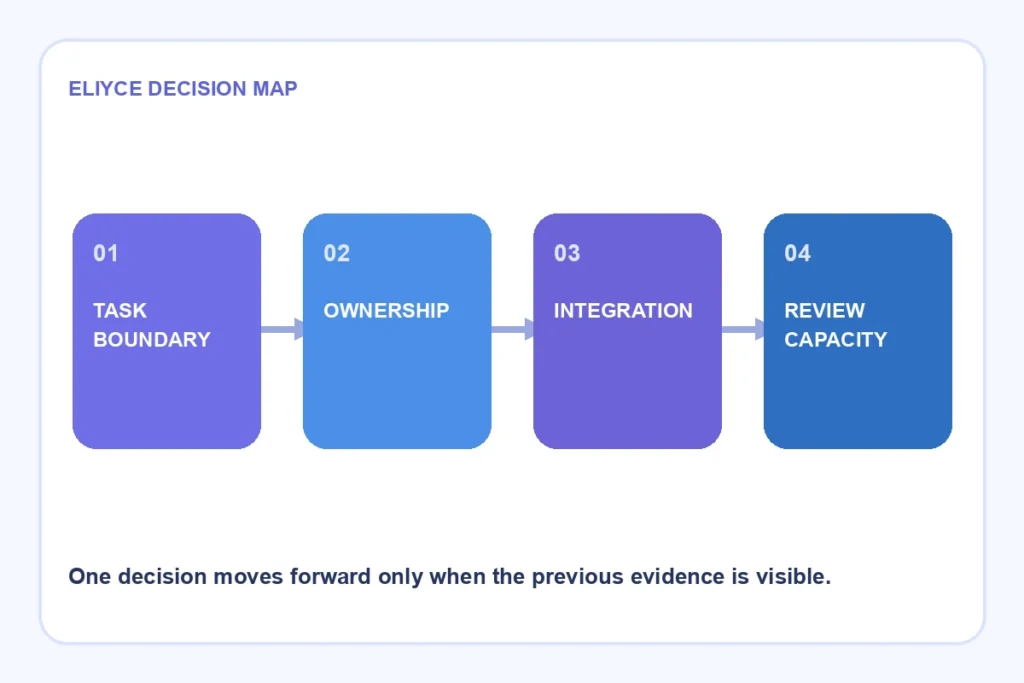
A useful task boundary completes one behaviour without requiring another unfinished branch. “Build the backend while another agent builds the interface” sounds independent, but it is not if neither side has an agreed contract. Settle the contract first, then let the implementations move separately.
Duplicate work hides inside different-looking solutions
Agents given overlapping goals may create two helpers, two validation paths or two interpretations of the same rule. Git may merge them cleanly because the files differ. The duplication becomes maintenance debt after release.
Keep a shared task ledger with the outcome, owner, touched boundaries and status. Before dispatch, search for work already in progress. Before merge, compare the branch against changes that landed since it started. A coordinator should reject unnecessary parallel implementations rather than choosing one only after both are polished.
- One outcome and one accountable human per agent task.
- Explicit files, modules and contracts the task may change.
- Dependencies on other active tasks recorded before work begins.
- A rebase or refresh point before final verification.
- An integration order and owner for shared surfaces.
Review capacity becomes the real concurrency limit
Generation can scale faster than review. Ten small pull requests arriving together still compete for the same people who understand the architecture, security model and product decision. Waiting diffs become stale, authors lose context and reviewers skim to keep the queue moving.
Set a work-in-progress limit based on how many changes the team can understand and integrate, rather than how many agent sessions it can start. A simple rule is to stop dispatching when the review queue reaches the team’s agreed limit. Help finish or verify existing work first.
GitHub’s guidance on stacking AI-generated pull requests addresses review bottlenecks by creating focused, ordered layers. Stacks help when work is dependent. For independent tasks, a queue with explicit priority may be clearer. Both approaches recognise that human attention is finite.
Integration needs its own definition of done
An agent’s branch can be complete while the combined system is not. Integration should verify interface compatibility, migrations, shared fixtures, end-to-end behaviour and the final assembled commit.
- Merge or rebase in the declared order.
- Resolve semantic conflicts, not only textual ones.
- Run checks that cross the affected boundaries.
- Inspect the combined diff for duplicated logic and accidental scope.
- Record evidence on the integrated commit before release approval.
The integration owner should understand the product outcome across branches. This person decides whether the pieces form one coherent change or whether the plan needs to be reduced.

Add concurrency only after flow is stable
More agents help when tasks are truly independent, checks are fast, boundaries are stable and reviewers have capacity. They hurt when requirements are still moving, the codebase has broad coupling or every change needs the same specialist.
Measure flow rather than agent activity: time waiting for review, conflict rate, rework after integration, pull-request age and the number of changes reopened because evidence was incomplete. These measures do not prove causality by themselves, but they reveal whether extra concurrency is creating usable throughput.
The article on routing tasks between AI models helps choose a tool for a task; the AI code evidence receipt explains what each task should return. Tool choice cannot compensate for missing coordination.
If your team is opening more agent tasks than it can integrate and verify, Fix this for your team. The Programme applies a shared workflow to real backlog work and compares it with your starting point, without promising a particular throughput gain.
One further control is a regular integration checkpoint. For active parallel work, compare task boundaries and landed changes before branches have time to diverge. The checkpoint need not be a meeting; a visible ledger update and an automated conflict check may be enough. What matters is that agents do not continue for hours against assumptions the team already changed.
Security and data-sensitive tasks deserve even tighter concurrency. Two branches that separately alter permissions may each look safe while their combined effect creates a gap. Route shared trust boundaries through one owner, and verify the assembled behaviour with negative cases. Parallel generation is least valuable where the cost of an inconsistent decision is highest. Keep that decision visible to every contributor before the next task begins.
Frequently Asked Questions
What breaks when teams run multiple coding agents?
Shared assumptions, ownership and review flow break first. Agents create conflicting or duplicate changes, branches become stale and reviewers receive more work than they can examine. Bound tasks, declare interfaces and limit work in progress before adding concurrency.
How do you stop multiple coding agents from changing the same files?
Assign temporary ownership for files or modules and expose active tasks in one ledger. The rule should tell an agent to stop and escalate when required work crosses another task’s boundary, rather than silently editing around it.
Can two coding agents work on the same feature safely?
Yes, when the feature can be divided by a stable contract and each part has an independent acceptance result. If both tasks need to discover the contract while coding, sequential work is usually safer and may finish sooner.
Who should resolve conflicts between agent branches?
A human integration owner should decide the intended combined behaviour. An agent may perform mechanical conflict resolution, but a person must review semantic choices, rerun cross-boundary tests and own the integrated result.
How many coding agents should one developer run at once?
There is no universal number. Use the smallest number that keeps independent work moving without growing the review queue or causing stale branches. Review capacity and coupling are better limits than available agent sessions.
What should teams measure before adding more coding agents?
Track time waiting for review, conflicts, integration rework, reopened changes and age of unfinished work. If these worsen as concurrency rises, the team is generating inventory rather than increasing completed, verified delivery.





